• About
  • Photography
  • Curatorial
  • Film
  • Travel
Menu

Malika Ali Harding

  • About
  • Photography
  • Curatorial
  • Film
  • Travel
×
Kathleen Cleaver, Photographed by Howard Bingham

Kathleen Cleaver, Photographed by Howard Bingham

Isn't It Beautiful?

Malika Ali March 10, 2014

Fifteen years ago, I assisted a documentary filmmaker in Boston, Mass.  He found me intellectually dull and hypocritically religious.  He was right.  I knew there was a tiny flame inside that hungered for the fuel of scholarly insight.  If only I could find the time to read a newspaper (print was still a big deal), then I could wow my mentor with a unique perspective on the international happenings of our day.  

Instead I struggled to make it through each day.  I was a single mother of two, living in a city where strangers had become family.  My closest relatives were a twelve-hour drive away.  I battled depression and bipolar illness, but was not aware of this diagnosis at the time.  Religion was my medicine.  It was good medicine.  It kept me reaching for the next day when my brain asked, "Why bother making it through the night?"  

I chose jobs that afforded the opportunity to either learn or create something new.  As a receptionist, I could sit at a desk and answer phones while writing my next big screenplay.  As an assistant documentarian, I had access to rare footage that told stories of the 20th century Black experience.  

It was during this time that I came across video of Kathleen Cleaver talking about her hair.  It was a short, powerful clip that struck me in such a way, I still think about it all these years later.  


"This brother here, myself, all of us were born with our hair like this.

And we just wear it like this, because it's natural.

The reason for it you might say...it's like a new awareness among Black people.

That their own natural appearance, this physical appearance is beautiful.

And it's pleasing to them.

For so many, many years we were told that only White people were beautiful.

Only straight hair, light eyes, light skin was beautiful.

And so Black women would try everything they could....

Straighten their hair, lighten their skin to look as much like White women.  

But this has changed because Black people are aware.

And White people are aware of it too, because White people now want natural wigs.

They want wigs like this.

Dig it?  

Isn't it beautiful?

- Kathleen Cleaver, 1968

I coupled this footage with symbol and typography to recall the role hair played in the protests and the power struggles of 1960's America.  

My installation, "Isn't It Beautiful," will be on exhibit for Woman. Hair. Power. @ The Ground Floor Gallery.

My former boss may never know the brilliant woman I've become, but you can catch a glimpse of the new and improved me on Saturday, March 29th during this one-day-only Women's History Event.

Tickets are available HERE.


In Contemporary Art, Culture, Politics
Comment
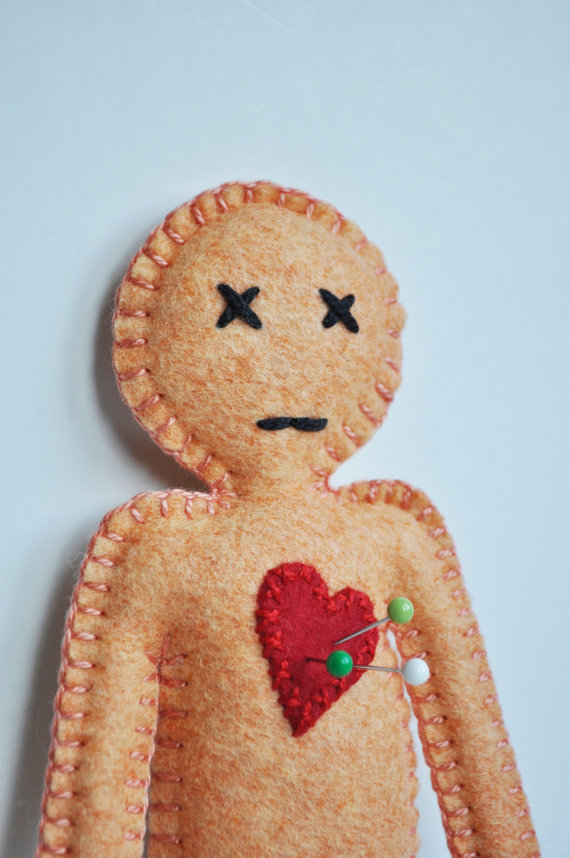
Doll crafted by Hibou Designs

Doll crafted by Hibou Designs

Voodoo on a Stick

Malika Ali February 24, 2014

Like many strange children before me, I suffered through elementary school.  I loved learning and was often the Teacher's doll.  To the kids around me though, I was anything but cute.  They considered me a freak of nature.  A weirdo.  I was taunted with names like "Voodoo on a Stick" and "Four Heads."  All because I was rail thin with a big head and even bigger eyes.  

So when my seven-year-old reported that she defended Christopher T. against some bullies, my heart went racing with pride. My daughter is champion of the outcasts!  A friend to the misfits!  These are the things I told myself.

I imagined Christopher T., this boy with a slue-foot, bestowing gratitude on my kid for coming to his rescue.  Weeks went by with increasing conversations about Christopher.  When she bragged about beating him in a race, I thought, 'Girl Power!'  I was glad she finished first, even if he did have a draggy foot.  

Soon she declared she and Chris were best friends.  And somehow they now shared emotions.  "Today was the worst day of our lives," she said after they both lost their reading charms.  

"Our daughter is a sensitive soul," I told my husband.

When the hubby went to volunteer at school, I got a call from the yard.  

"Christopher T. is a distraction to our kid."

"The slue-footed boy?"

"No!  You got the wrong one.  This boy does not have a slue-foot."

When I went to gather her later that day, the Playground Supervisor pulled me aside.

"I wanted to tell you that Chris T. would play basketball every day after school.  Now all he does is hang out with your kid.  It's quite cute."

"Who is this boy?" I asked.

 "Chris!" the Supervisor yelled.

Chris T. turned.  In slow motion it seemed.  My question answered.  This was Boy Wonder.

I sighed deeply.  Probably my longest exhale ever.  My brain was not prepared for the real Christopher. 

"Oh," I said to the Supervisor.

"Yep," she replied.

The Supervisor rubbed my shoulders soothingly.

Maybe one day my daughter will make my 'hero of the weird bunch' tale come true.  

Until then, I've got my eye on Christopher T.

In Family, Culture
Comment
My youngest learning about Harriet Tubman.  Photographed by her dad Brian Ali Harding

My youngest learning about Harriet Tubman.  Photographed by her dad Brian Ali Harding

What Not to Teach Your Kids This Black History Month

Malika Ali February 17, 2014

Every year we find a way to screw up the Black History Lessons we teach our offspring.  I believe in the importance of educating children in the cultural contributions of our forefolk.  But how do you properly teach lynching to a little kid?  

I sugarcoat way too much already.  The Tooth Fairy. The Binky Fairy. Old Saint Nick.  I don't want my babies to grow up and discover that I've done nothing but make shit up their entire lives.  So I try to teach the cold, hard facts of America's fine past in a child friendly manner.  I try, but sometimes it backfires.

Take for instance, when my teenager was 8 years old we read this book together...

Remember.jpg

When she asked if she could share it in school, I was delighted.  "Of course!  It's Black History Month.  Why Not?"  Her elementary at the time was about 6% African American.  What greater way to chat up old times than in an academic setting?

We brought the book to school the very next day and spoke with her teacher.  Mrs. Funaki, visibly hesitant, pulled a chair to the front of the class.  My kid sat, opened Toni Morrison and paraphrased the subtext out loud to her classmates:

"Back in the day, back in the day White people were crazy!"

She then showed a picture that looked something like this...

Photograph Don Hogan Charles/The New York Times

Photograph Don Hogan Charles/The New York Times

Imagine a class full of gaping-mouthed third graders.  Imagine the conversations they had with their parents after school.  Imagine how the teacher avoided eye contact with me the rest of the school year.

There must be a kid friendlier way to tackle the sordid portions of our past.  

How does your family approach Black History?


In Family, Culture, Politics
3 Comments
← NewerOlder →

Search Posts


Featured Posts